Airports · Saramacca
Henri Alwies Airstrip (SMHA)
Saramacca
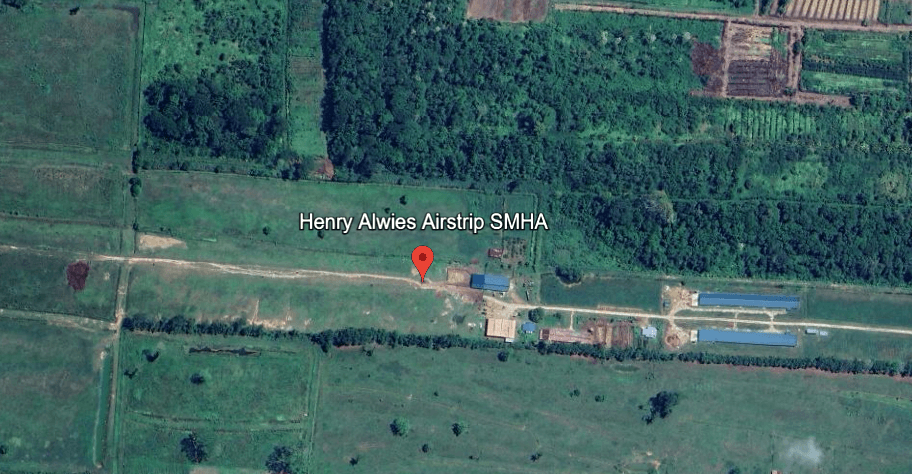
Henri Alwies Airstrip (Dutch: Henri Alwies Vliegveld; IATA code: SMHA) is a small public airstrip located near Antongron in the Saramacca District of Suriname. It is one of Suriname’s newer airstrips, officially opened and in use since April 5, 2012. Henri Alwies Airstrip was developed as a base for agricultural aviation and gliding activities: Primary use: Home base of ERK Farms, a crop‑dusting operator. Heavily used by the glider club Zweefvliegclub Akka for sailplane operations.
Local rules
Physical access The airstrip is in a rural/agricultural area near Antongron. Road access is via local district roads from the Paramaribo–Nieuw Nickerie corridor; exact access tracks are informal and may be unpaved. There is no public terminal building; the site consists mainly of a runway strip and open field used by operators based there. Operational rules (aviation) Suriname’s civil aviation regulations apply. Key points relevant to Henri Alwies: Designated aerodrome: All civil aircraft must land at and take off from designated aerodromes unless the Minister grants an exemption. Henri Alwies is a recognized airstrip, so normal operations are permitted for authorized users. Airspace and permissions: Operations within the lateral boundaries of controlled airspace around an aerodrome require authorization from the relevant ATC facility. Most small airstrips like Henri Alwies operate under VFR (visual flight rules); IFR instrument approaches are only available at Johan Adolf Pengel International Airport (PBM). Security and restricted areas: Persons may not enter restricted parts of an aerodrome without authorization; trespassing in non‑public areas can lead to penalties under national law. Access to restricted zones requires an Aerodrome Restricted Area pass or explicit permission from the aerodrome operator/tenant. Charges (if using government aerodromes): While Henri Alwies is mainly used by specific operators, national rules set standard charges for landing and parking at government‑operated aerodromes (e.g., landing charge ~US$3 per 1,000 kg MTOW; parking fees after 4 hours). In practice, regular users (ERK Farms, glider club) operate under their own arrangements. Ground access for non‑aviation visitors The area is not a public tourist site; access is generally for: Authorized aviation personnel Employees of crop‑dusting or gliding operations Invited guests or contractors Casual public access may be restricted by the operators (ERK Farms, glider club) for safety and security.
Nearest help
There is no permanent airport authority office, control tower, or on‑site medical facility at Henri Alwies Airstrip; it is an uncontrolled grass/short‑runway airstrip. Nearest practical help points: Paramaribo (capital) – approx. 30–40 km east/southeast: Main hospitals, police, fire, and government aviation offices are in Paramaribo. Zorg en Hoop Airport (SMZO) is the main domestic hub from which most flights to interior airstrips depart. Saramacca district centers (e.g., Groningen, Batavia, Kwatta area): Local clinics, police posts, and basic services are available in these towns, all within roughly 10–25 km depending on exact location. Aviation oversight: CADSUR (Civil Aviation Department Suriname / Luchtvaartdienst) – national aviation authority, located in Paramaribo: Address: Doekhieweg Oost #1, Paramaribo, Suriname Phone: +597 498 898 Email: info@cadsur.sr (general) and cat.atmcns@tct.gov.sr (air traffic / safety matters) For emergencies from the airstrip itself, users rely on mobile phones and coordination with Paramaribo‑based services (police, medical, CADSUR, or the operating company such as ERK Farms).
Last verified 2026-10-07 · version 2
Confirm the exact meeting point with your operator.
- Coordinates
- 5.83194, -55.6375
- Contact
- +597 498 898 · info@cadsur.sr
Save essential contacts before departure. Agree who checks your arrival and how to communicate if mobile reception is lost.
Safety protocols to read before you travel
A01Guided activitiesUse a guide who knows the route and explains the safety arrangements.
Choose a guide through an established operator and ask about route experience, training, equipment and emergency arrangements. Follow the safety briefing, stay with the group and do not undertake an unfamiliar activity alone. Stop when conditions become unsafe.
Version 1 · Reviewed 2026-12-15 · Source SCSD project Revised Deliverable 2 and Workshop 1 protocol guidance
A02Jungle excursionsStay on known trails, share the route and carry essential supplies.
Stay on marked or known trails, tell someone the intended route and carry water, communications and a basic first-aid kit. Avoid excursions during severe weather.
Version 2 · Reviewed 2026-12-15 · Source Rev. - DELIVERABLE 2 REPORT - Tourism Awareness&Saferty SCSD project.docx, section 3.3; draft pending TCT/PIU approval
A03Water recreation and river hazardsCheck physical hazards and fresh-water health risks before an activity.
Ask the guide about currents, rocks, water levels and safe access before any water activity. Wear suitable flotation equipment for boating. Do not dive into unfamiliar water or enter rapids to swim or bathe, and keep children under close supervision. CDC advises avoiding swimming in unchlorinated rivers, lakes and ponds in Suriname because fresh water can carry infections. A locally designated swimming spot does not establish water quality.
Version 1 · Reviewed 2026-12-15 · Source SCSD project Revised Deliverable 2 and Workshop 1 protocol guidance; https://wwwnc.cdc.gov/travel/destinations/traveler/none/suriname
A04Wildlife awarenessDo not approach or feed wildlife; report dangerous sightings.
Do not approach or feed wildlife and do not handle unknown plants or animals. Keep a safe distance and report dangerous wildlife sightings to the guide or responsible local contact.
Version 1 · Reviewed 2026-12-15 · Source Rev. - DELIVERABLE 2 REPORT - Tourism Awareness&Saferty SCSD project.docx, section 3.3; draft pending TCT/PIU approval