Airports · Saramacca
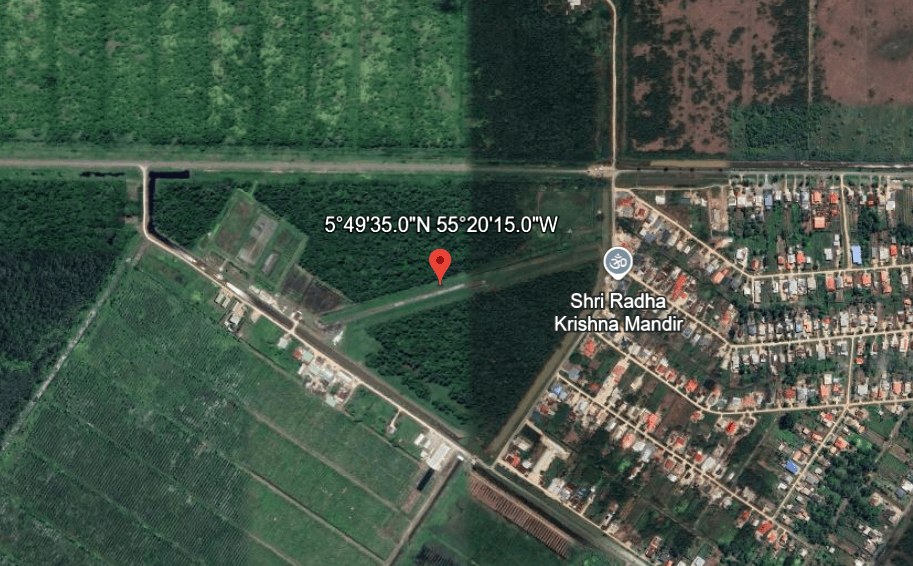
Jarikaba Airstrip
Saramacca
Jarikaba Airstrip (ICAO: SMJA) is a small, mixed‑surface airstrip serving the town of Jarikaba in the Saramacca District, just west of Paramaribo, Suriname.
Local rules
Jarikaba Airstrip is a non‑scheduled, small airstrip in Suriname. In practice: Prior permission is required for any non‑scheduled flight (private, charter, military, etc.) into Surinamese airspace and for landings at Surinamese aerodromes, including small airstrips. The Civil Aviation Department (CAD / CAA) of Suriname handles overflight and landing permits. Operators typically must: Apply at least 48 hours to 3 days before the planned flight. Submit flight details, aircraft documents (registration, airworthiness, insurance, etc.), and for landings, crew/passenger manifests and yellow‑fever vaccination certificates for crew. A ground handler is normally required for non‑scheduled landings at major airports; while Jarikaba itself is very basic, operators still coordinate through local agents or the CAA for permissions and any required services. There is no published public “open access” rule for SMJA like for a public airfield in some countries; it functions as a regulated Surinamese aerodrome under the national aviation authority. For the most current, detailed rules (frequencies, operating hours if any, specific local procedures), you would consult: Suriname’s AIP (Aeronautical Information Publication) and NOTAMs via the official AIS site: https://cadsur.sr/ais/ Or contact the CAA of Suriname directly
Nearest help
For practical “nearest help” in case of an issue at Jarikaba Airstrip, the closest significant resources are in and around Paramaribo: Paramaribo–Zorg en Hoop Airport (SMZO) – the main domestic/charter airport in Paramaribo, used by the same charter operators that serve Jarikaba. This is the nearest formal airport with regular aviation services. Johan Adolf Pengel International Airport (SMJP / PBM) – Suriname’s main international airport, about 44 km (24 nm) NNW of Jarikaba Airstrip, with full ATC, customs, medical, and handling services. Jarikaba town itself (population ~5,963 in 2012) has local shops, basic services, and road access to Paramaribo; for serious emergencies, Paramaribo’s hospitals and emergency services are the nearest advanced care. Road access from Jarikaba to central Paramaribo is straightforward via the main west–east road network, so ground transport to hospitals, police, or aviation authorities in the capital is relatively quick.
Last verified 2026-10-07 · version 3
Confirm the exact meeting point with your operator.
- Coordinates
- 5.826248, -55.337255
Save essential contacts before departure. Agree who checks your arrival and how to communicate if mobile reception is lost.
Safety protocols to read before you travel
A01Guided activitiesUse a guide who knows the route and explains the safety arrangements.
Choose a guide through an established operator and ask about route experience, training, equipment and emergency arrangements. Follow the safety briefing, stay with the group and do not undertake an unfamiliar activity alone. Stop when conditions become unsafe.
Version 1 · Reviewed 2026-12-15 · Source SCSD project Revised Deliverable 2 and Workshop 1 protocol guidance
A02Jungle excursionsStay on known trails, share the route and carry essential supplies.
Stay on marked or known trails, tell someone the intended route and carry water, communications and a basic first-aid kit. Avoid excursions during severe weather.
Version 2 · Reviewed 2026-12-15 · Source Rev. - DELIVERABLE 2 REPORT - Tourism Awareness&Saferty SCSD project.docx, section 3.3; draft pending TCT/PIU approval
A03Water recreation and river hazardsCheck physical hazards and fresh-water health risks before an activity.
Ask the guide about currents, rocks, water levels and safe access before any water activity. Wear suitable flotation equipment for boating. Do not dive into unfamiliar water or enter rapids to swim or bathe, and keep children under close supervision. CDC advises avoiding swimming in unchlorinated rivers, lakes and ponds in Suriname because fresh water can carry infections. A locally designated swimming spot does not establish water quality.
Version 1 · Reviewed 2026-12-15 · Source SCSD project Revised Deliverable 2 and Workshop 1 protocol guidance; https://wwwnc.cdc.gov/travel/destinations/traveler/none/suriname
A04Wildlife awarenessDo not approach or feed wildlife; report dangerous sightings.
Do not approach or feed wildlife and do not handle unknown plants or animals. Keep a safe distance and report dangerous wildlife sightings to the guide or responsible local contact.
Version 1 · Reviewed 2026-12-15 · Source Rev. - DELIVERABLE 2 REPORT - Tourism Awareness&Saferty SCSD project.docx, section 3.3; draft pending TCT/PIU approval