Airports
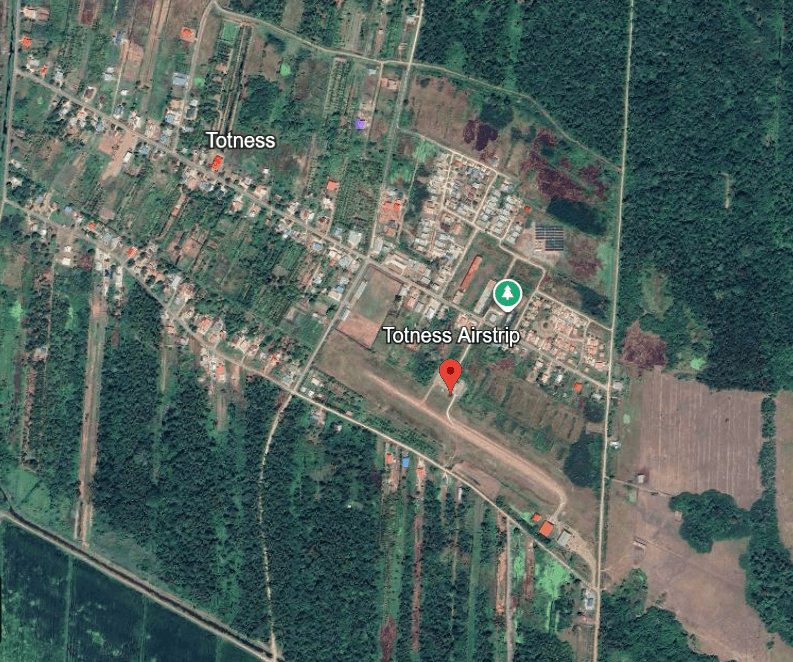
Totness Airstrip
Totness Airstrip serves the town of Totness, which is the administrative center of the Coronie District on Suriname's northern coastal plain. The airstrip is one of the oldest aviation facilities in Suriname and primarily supports charter flights, government operations, medical access, and regional transportation.
Local rules
Totness is a public airstrip but operations are controlled under Suriname’s civil aviation rules. Key points for pilots/operators: Regulatory authority Civil Aviation Authority (CADS / Luchtvaartdienst Suriname) under the Ministry of Transport, Communication and Tourism. Contact points (Paramaribo): Department of Civil Aviation (CAD): Tel: +597 498898 / +597 497914 Email: cat.atmcns@tct.gov.sr Civil Aviation Safety Authority Suriname (CASAS): Tel: +597 434186 / 431990 Email: casas@sr.net Website: http://www.casas.sr Aeronautical Information Service (AIS): Tel: +597 499561 (ext. 237/252) Email: aissuriname@yahoo.com or cad.ais@tct.gov.sr For transport-policy and air transport oversight, the Ministry lists an Onderdirecteur Luchttransport (Air Transport) with emails such as secr.odtra.tct@gmail.com and od.luchttransport.tct@gmail.com, tel +597 462539 (ext. 202/203). Landing permits & flight rules Landing permit: Required for aircraft landing in Suriname, including at regional airstrips like Totness. Applications are typically submitted at least 72 hours before the flight via CADS (sometimes online). Permit validity: Usually for a specific date, time, airport, and aircraft registration; changes must be notified in advance. VFR flights: Must be authorized by the appropriate ATS authority; VFR is not permitted without such authorization. Night operations: Flights between sunset and sunrise require specific approval from ATS. Flight plan / notification: The filed flight plan is treated as advance notification to public authorities; it should reach them at least 2 hours before arrival. Entry documents on arrival (typical for international/general aviation into Suriname, including regional airports when used for international or non-scheduled traffic): General Declaration (multiple copies for Customs, Immigration, Health, Airport Manager, Plant Protection) Passenger Manifest (copies for Customs, Immigration, Airport Manager) Standard aircraft documents: AOC (if applicable), Certificate of Airworthiness, Insurance, Registration, Noise compliance, etc. For purely domestic charter/crop-dusting operations (e.g., Blue Wing Airlines, Gum Air, Hi-Jet, Coronie Aero Farming, Overeem Air Service), operators coordinate directly with Luchtvaartdienst and local authorities under established agreements. Local access & area considerations The airstrip is in a coastal, low-lying district (Coronie) with villages, plantations, and nature areas nearby. Access to the immediate airfield area is generally controlled as an aviation facility; unauthorized ground access may be restricted by local security or aviation rules. There is no publicly listed “airport manager” phone/email specifically for Totness; operational queries are normally handled through Luchtvaartdienst Suriname / CADS in Paramaribo or via the charter operators who regularly use the strip.
Nearest help
Medical help Totness Hospital Address (from open-data sources): Johannes S. P. Kraagweg, Totness. Listed as an emergency-capable facility in community data, though no verified phone number is published in those directories. Emergency numbers (national, applicable in Coronie): Ambulance / medical emergency: 113 General emergency (police / fire / medical): 112 or 115 in some guidance; local listings also show 113 for ambulance and emergency care. For serious cases beyond Totness, patients are typically referred to larger hospitals in Nieuw Nickerie (Streekziekenhuis Nickerie – Dr. L. Mungra Medisch Centrum) or Paramaribo (Academisch Ziekenhuis, Diakonessenhuis, etc.). Police / security Local police presence is in Totness as the district capital; national emergency number for police is 112. Specific local station phone numbers for Coronie/Totness are not consistently published online; in practice, residents use the national emergency line or local district office contacts. Fire / rescue National fire/emergency number: 112 (also used for integrated emergency response)
Version 2 · no verification date recorded
Confirm the exact meeting point with your operator.
- Coordinates
- 5.865952, -56.327763
Save essential contacts before departure. Agree who checks your arrival and how to communicate if mobile reception is lost.
Safety protocols to read before you travel
A01Guided activitiesUse a guide who knows the route and explains the safety arrangements.
Choose a guide through an established operator and ask about route experience, training, equipment and emergency arrangements. Follow the safety briefing, stay with the group and do not undertake an unfamiliar activity alone. Stop when conditions become unsafe.
Version 1 · Reviewed 2026-12-15 · Source SCSD project Revised Deliverable 2 and Workshop 1 protocol guidance
A02Jungle excursionsStay on known trails, share the route and carry essential supplies.
Stay on marked or known trails, tell someone the intended route and carry water, communications and a basic first-aid kit. Avoid excursions during severe weather.
Version 2 · Reviewed 2026-12-15 · Source Rev. - DELIVERABLE 2 REPORT - Tourism Awareness&Saferty SCSD project.docx, section 3.3; draft pending TCT/PIU approval
A03Water recreation and river hazardsCheck physical hazards and fresh-water health risks before an activity.
Ask the guide about currents, rocks, water levels and safe access before any water activity. Wear suitable flotation equipment for boating. Do not dive into unfamiliar water or enter rapids to swim or bathe, and keep children under close supervision. CDC advises avoiding swimming in unchlorinated rivers, lakes and ponds in Suriname because fresh water can carry infections. A locally designated swimming spot does not establish water quality.
Version 1 · Reviewed 2026-12-15 · Source SCSD project Revised Deliverable 2 and Workshop 1 protocol guidance; https://wwwnc.cdc.gov/travel/destinations/traveler/none/suriname
A04Wildlife awarenessDo not approach or feed wildlife; report dangerous sightings.
Do not approach or feed wildlife and do not handle unknown plants or animals. Keep a safe distance and report dangerous wildlife sightings to the guide or responsible local contact.
Version 1 · Reviewed 2026-12-15 · Source Rev. - DELIVERABLE 2 REPORT - Tourism Awareness&Saferty SCSD project.docx, section 3.3; draft pending TCT/PIU approval