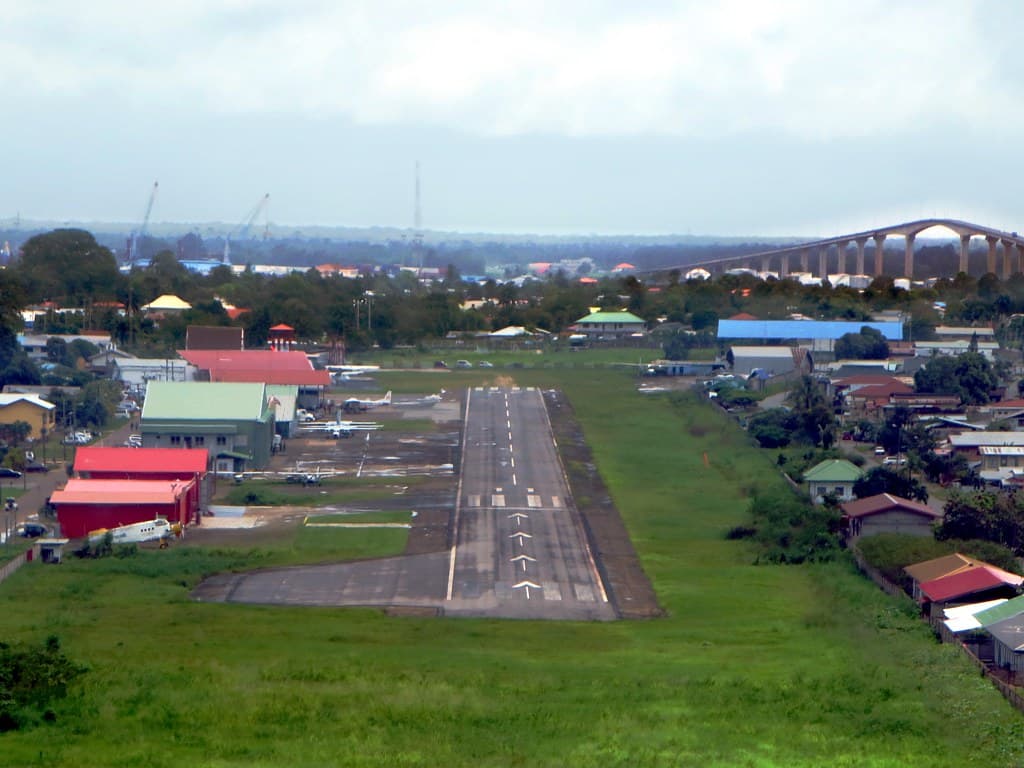
Airports · Doekhieweg Oost, Paramaribo, Suriname
Zorg en Hoop Airport
Doekhieweg Oost, Paramaribo, Suriname
Zorg en Hoop Airport is Suriname’s secondary airport and the main domestic/city airport for Paramaribo. It handles scheduled domestic flights, charters, and general aviation, while international traffic primarily uses Johan Adolf Pengel International Airport (PBM) south of the city. Zorg en Hoop, Paramaribo airport used for smaller aircraft and flights to the interior. Reach the operator terminal by road. Confirm departure terminal and check-in with the airline. The pin marks the general place; confirm the exact meeting point.
Local rules
Confirm the boarding point, departure arrangements and baggage instructions with your operator. Follow staff instructions. Connectivity: Save the map and important numbers before travel. Ask your operator which communication arrangements are available if mobile reception is lost. Getting there: From central Paramaribo, it’s a 10–15 minute drive; taxis and ride services operate in the city. Flights: Most scheduled services are domestic (interior towns) via Gum Air and Blue Wing; check current timetables, as frequencies can change. Permissions: For non‑scheduled, charter, or foreign‑registered aircraft, contact CASAS and the Department of Civil Aviation well in advance to confirm landing permits, customs arrangements, and any PPR requirements. Emergency: Use 115 for police/ambulance/fire; for aviation accidents/incidents, the airport operator and CASAS coordinate with national responders. If you tell me your use case (private pilot, charter operator, researcher, traveler), I can tailor a short checklist specific to Zorg en Hoop and the Surinamese interior airstrips.
Nearest help
Zorg en Hoop is inside Paramaribo, so “nearest help” is essentially the city’s emergency and medical infrastructure: Emergency number (general): In Suriname, the standard emergency number is 115 (police/ambulance/fire). This applies in Paramaribo and therefore for incidents at/near Zorg en Hoop. Hospitals near Paramaribo (for medical emergencies after stabilization/transport from the airport): Academisch Ziekenhuis Paramaribo (AZP) – the main teaching hospital in Paramaribo. ’s Lands Hospitaal – another major public hospital in the capital. Exact distances depend on your route, but both are within the Paramaribo urban area, typically a short drive from the airport. Police: The nearest police station will be a Paramaribo district station; in an emergency, call 115 and specify “Zorg en Hoop Airport, Paramaribo.” For aviation‑specific emergencies (accident/incident on the aerodrome), the airport operator and CASAS coordinate with national emergency services; pilots should follow standard emergency procedures and contact the tower/airport frequency if available or use the national emergency number if off‑frequency.
Last verified 2026-09-10 · version 2
Confirm the exact meeting point with your operator.
- Coordinates
- 5.811111, -55.190278
Save essential contacts before departure. Agree who checks your arrival and how to communicate if mobile reception is lost.
Safety protocols to read before you travel
A01Guided activitiesUse a guide who knows the route and explains the safety arrangements.
Choose a guide through an established operator and ask about route experience, training, equipment and emergency arrangements. Follow the safety briefing, stay with the group and do not undertake an unfamiliar activity alone. Stop when conditions become unsafe.
Version 1 · Reviewed 2026-12-15 · Source SCSD project Revised Deliverable 2 and Workshop 1 protocol guidance
A02Jungle excursionsStay on known trails, share the route and carry essential supplies.
Stay on marked or known trails, tell someone the intended route and carry water, communications and a basic first-aid kit. Avoid excursions during severe weather.
Version 2 · Reviewed 2026-12-15 · Source Rev. - DELIVERABLE 2 REPORT - Tourism Awareness&Saferty SCSD project.docx, section 3.3; draft pending TCT/PIU approval
A03Water recreation and river hazardsCheck physical hazards and fresh-water health risks before an activity.
Ask the guide about currents, rocks, water levels and safe access before any water activity. Wear suitable flotation equipment for boating. Do not dive into unfamiliar water or enter rapids to swim or bathe, and keep children under close supervision. CDC advises avoiding swimming in unchlorinated rivers, lakes and ponds in Suriname because fresh water can carry infections. A locally designated swimming spot does not establish water quality.
Version 1 · Reviewed 2026-12-15 · Source SCSD project Revised Deliverable 2 and Workshop 1 protocol guidance; https://wwwnc.cdc.gov/travel/destinations/traveler/none/suriname
A04Wildlife awarenessDo not approach or feed wildlife; report dangerous sightings.
Do not approach or feed wildlife and do not handle unknown plants or animals. Keep a safe distance and report dangerous wildlife sightings to the guide or responsible local contact.
Version 1 · Reviewed 2026-12-15 · Source Rev. - DELIVERABLE 2 REPORT - Tourism Awareness&Saferty SCSD project.docx, section 3.3; draft pending TCT/PIU approval